AI for Business: How Artificial Intelligence Is Helping U.S. Companies Work Smarter
Introduction
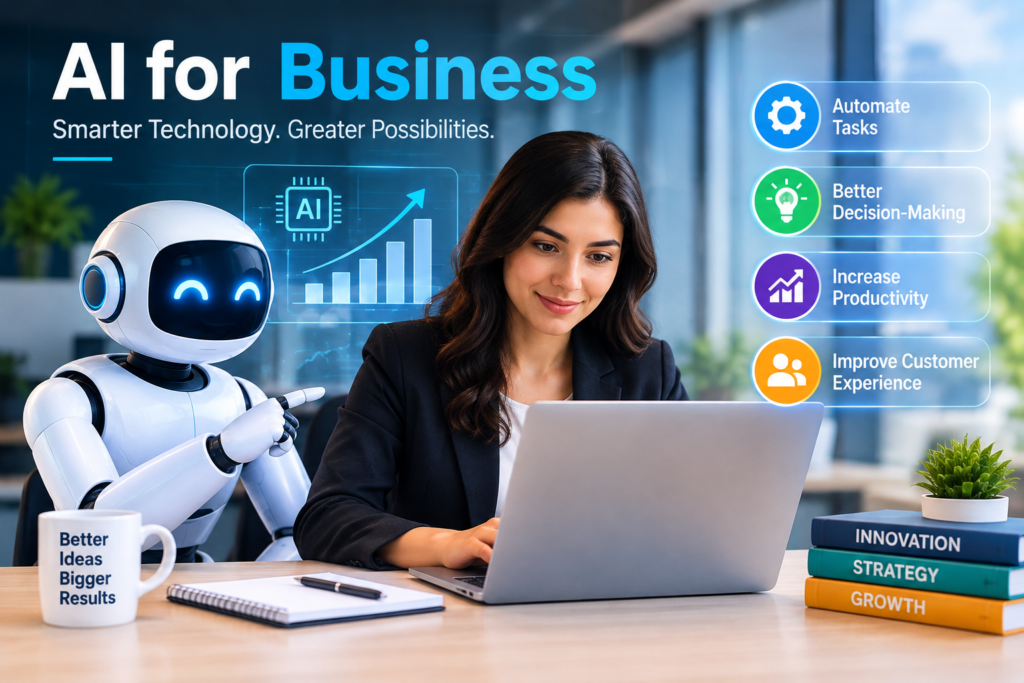
Artificial intelligence is no longer a futuristic concept reserved for large technology companies. Across the United States, businesses of every size are using AI for Business to improve customer service, streamline daily operations, make better decisions, and uncover new opportunities for growth. From neighborhood retailers to national enterprises, AI has become a practical business tool rather than an experimental technology.
The key to success isn’t replacing people with machines. Instead, it’s using AI to automate repetitive tasks, analyze data more efficiently, and give employees more time to focus on creative and strategic work. When implemented thoughtfully, AI can help businesses reduce costs, improve productivity, and deliver better customer experiences.
This guide explains how AI for business works, its benefits, real-world applications, challenges, and best practices for companies in the United States.
What Is AI for Business?
AI for business refers to the use of artificial intelligence technologies to improve business operations, support decision-making, automate workflows, and enhance customer interactions. AI for Business systems can analyze large amounts of information, recognize patterns, generate content, predict trends, and complete routine tasks much faster than manual processes.
Today, many companies use AI without even realizing it. Email spam filters, personalized product recommendations, virtual assistants, fraud detection systems, and customer support chatbots are all common examples of AI in action.
Why AI Matters for U.S. Businesses
The American business landscape is highly competitive. Companies are constantly looking for ways to improve efficiency while meeting growing customer expectations. AI for Business helps organizations stay competitive by simplifying complex processes and providing valuable insights from data.
Some of the biggest advantages include:
Increased productivity
Faster business decisions
Lower operational costs
Better customer experiences
Improved marketing performance
More accurate forecasting
Enhanced cybersecurity monitoring
Scalable business operations
Businesses that adopt AI strategically are often better positioned to respond to market changes and customer demands.
Common Uses of AI in Business
Customer Service
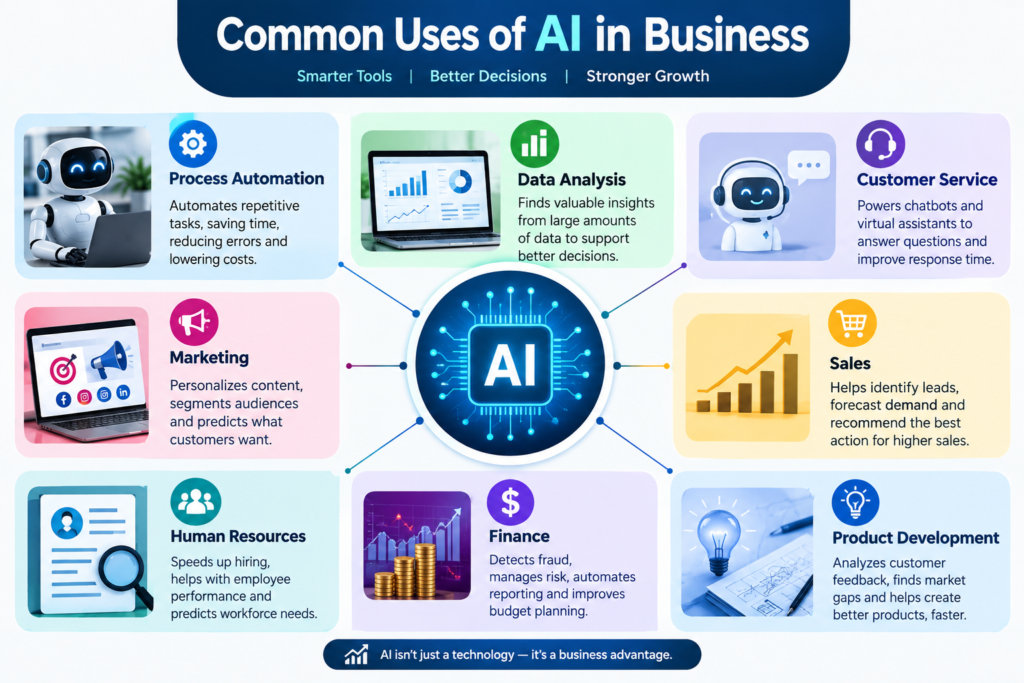
Many U.S. companies use AI-powered chatbots and virtual assistants to answer customer questions around the clock. These tools can resolve common issues, guide customers through purchases, and reduce wait times while allowing human representatives to focus on more complex requests.
Marketing and Content Creation
AI for Business helps marketing teams analyze customer behavior, identify trends, and personalize campaigns. Businesses can also use AI to generate content ideas, optimize email marketing, improve search engine optimization, and create targeted advertisements.
While AI speeds up content production, human editing remains essential to maintain quality, accuracy, and brand voice.
Sales and Lead Generation
Sales teams use AI to identify promising leads, predict buying behavior, and recommend the next best actions. AI-powered customer relationship management (CRM) platforms help businesses nurture prospects more efficiently and improve conversion rates.
Human Resources
Recruiters use AI to screen resumes, organize candidate information, and schedule interviews. AI can also support employee onboarding, training recommendations, and workforce planning while helping HR teams save valuable time.
Finance and Accounting
Financial departments benefit from AI for Business by automating invoice processing, detecting unusual transactions, forecasting revenue, and identifying financial risks. These capabilities improve accuracy while reducing manual workloads.
Supply Chain Management
AI helps businesses forecast demand, optimize inventory levels, improve delivery routes, and reduce supply chain disruptions. This leads to better operational efficiency and lower costs.
Benefits of AI for Small Businesses
AI is no longer limited to large corporations with massive budgets. Many affordable AI tools are designed specifically for small and medium-sized businesses across the United States.
Small businesses can use AI to:
Automate repetitive administrative tasks
Improve customer support
Manage appointments
Generate marketing ideas
Analyze sales data
Personalize customer communication
Improve inventory management
Cloud-based AI services make advanced technology more accessible than ever before.
Challenges Businesses Should Consider
Although AI offers significant benefits, implementation requires careful planning.
Some common challenges include:
Data privacy concerns
Employee training requirements
Initial implementation costs
Integration with existing systems
Maintaining data accuracy
Ethical use of AI
Cybersecurity risks
Successful AI adoption depends on balancing technology with responsible business practices.
Best Practices for Implementing AI
Start with a Clear Goal
Rather than using AI simply because it’s popular, identify a specific business problem you want to solve. Clear objectives make implementation more effective and measurable.
Choose the Right Tools
Not every AI platform fits every business. Evaluate features, pricing, ease of use, security, and customer support before making a decision.
Protect Customer Data
Businesses operating in the U.S. should prioritize data security and comply with applicable privacy regulations. Customers are more likely to trust companies that handle their information responsibly.
Train Your Team
AI works best when employees understand how to use it effectively. Provide training so your team can work alongside AI tools instead of viewing them as replacements.
Monitor Results
Track productivity, customer satisfaction, cost savings, and operational improvements. Measuring performance helps determine whether your AI investment is delivering real business value.
The Future of AI in Business
Artificial intelligence continues to evolve rapidly. In the coming years, businesses are expected to adopt more advanced automation, predictive analytics, personalized customer experiences, and intelligent decision-support systems.
Companies that embrace AI thoughtfully while maintaining a human-centered approach are likely to gain a competitive advantage in an increasingly digital economy.
Conclusion
AI for business is transforming how companies across the United States operate. Whether improving customer service, automating routine tasks, strengthening marketing efforts, or supporting smarter decision-making, artificial intelligence offers practical solutions that can help businesses grow more efficiently.
The most successful organizations view AI as a tool that enhances human expertise rather than replacing it. By combining innovative technology with skilled employees and a clear business strategy, companies can unlock new opportunities, improve productivity, and build stronger relationships with their customers in today’s competitive marketplace.